Cross Chess 2019
A downloadable game
The Pitch
Cross Chess is a two-player board game that transplants the pieces of International Chess and Chinese Chess (Xiangqi) onto each other's boards. Xiangqi pieces navigate the 8×8 grid; Western pieces occupy the 9×10 intersection board. Each piece retains its original movement rules — but on alien terrain, everything you know is wrong.
No downloads. Print the rules, grab two boards and two sets of pieces, and play.
Key Features
- Familiar Yet Foreign: Every piece moves exactly as you learned it — but on the wrong board. The Xiangqi General roams the open 8×8 field with no Palace to hide in. The International King is trapped inside a 3×3 fortress it never asked for.
- Cannon Deleted: The Cannon has no Western equivalent, so it simply doesn't exist on the 8×8 board. Its absence reshapes the entire opening.
- Double Queen Fortress: On the 9×10 board, two Queens occupy the Advisor positions — powerful but permanently confined to the Palace.
- Split Pawn Logic: Pawns placed in Cannon positions may advance 2 squares on their first move; Pawns in Soldier positions may only advance 1. A small asymmetry with deep consequences.
- Zero Components Required: If you own a chess set and a Xiangqi set, you already own Cross Chess.
Technical Specifications
| Players | 2 |
| Playtime | 30 – 60 minutes (estimated) |
| Components | 1 standard 8×8 chessboard, 1 standard 9×10 Xiangqi board, 1 International Chess set, 1 Xiangqi set |
| Language | Language-independent (piece recognition only) |
Theme Interpretation
This game was created solo in 48 hours at the Goethe Institute Beijing Game Jam (May 31 – June 2, 2019).
- Theme: Multi-Perspective
- Interpretation: Two of the world's most ancient strategy games — one born in India and shaped by Europe, the other rooted in China — encode fundamentally different spatial philosophies. International Chess uses a filled grid; Xiangqi uses intersections. One has a Queen that dominates the board; the other has a Cannon that leaps over allies. Cross Chess forces players to inhabit the other tradition's spatial logic while using their own tradition's pieces — literally playing from a "multi-perspective."
Complete Rules
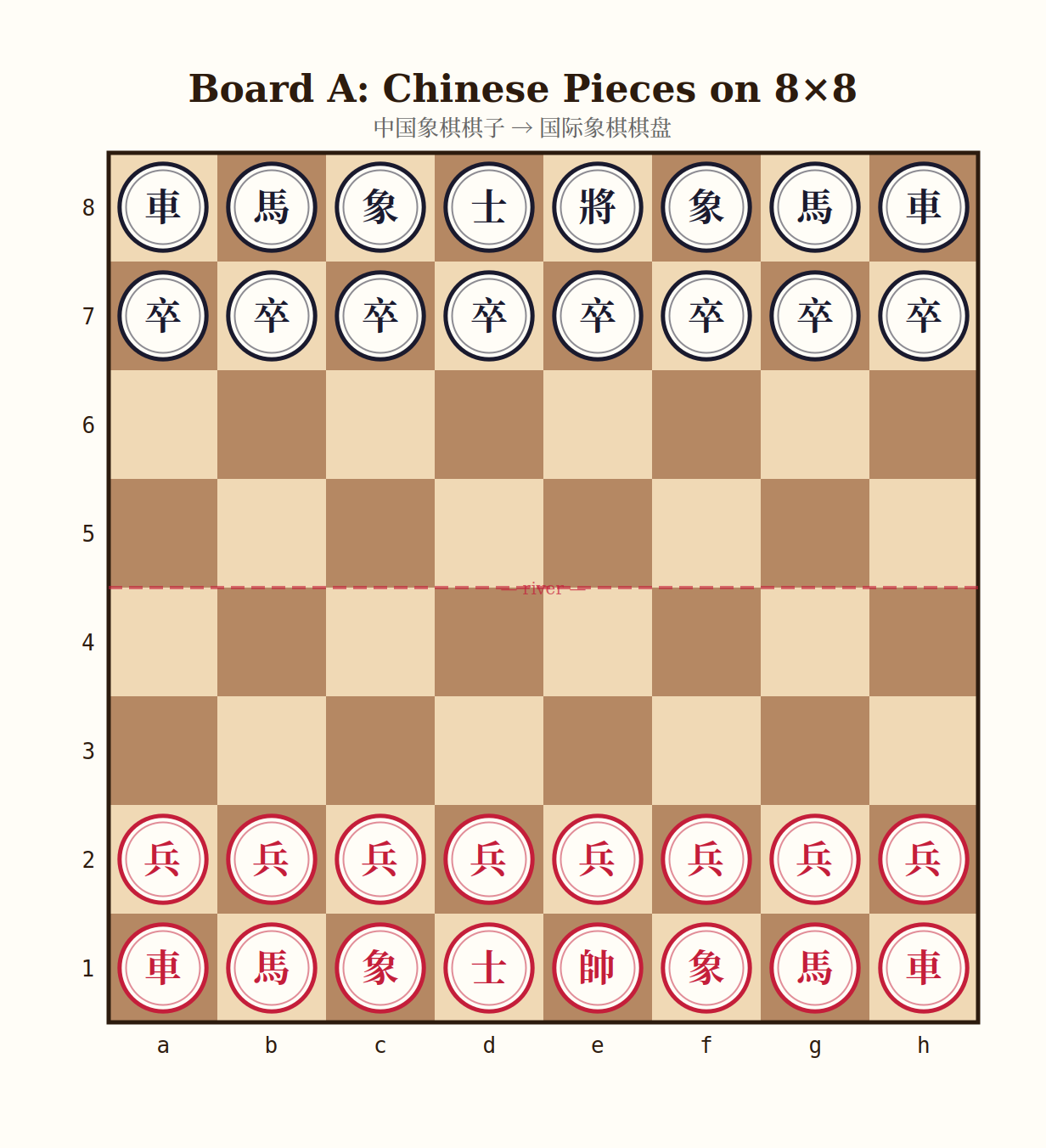
Board A — Xiangqi Pieces on an 8×8 Chessboard
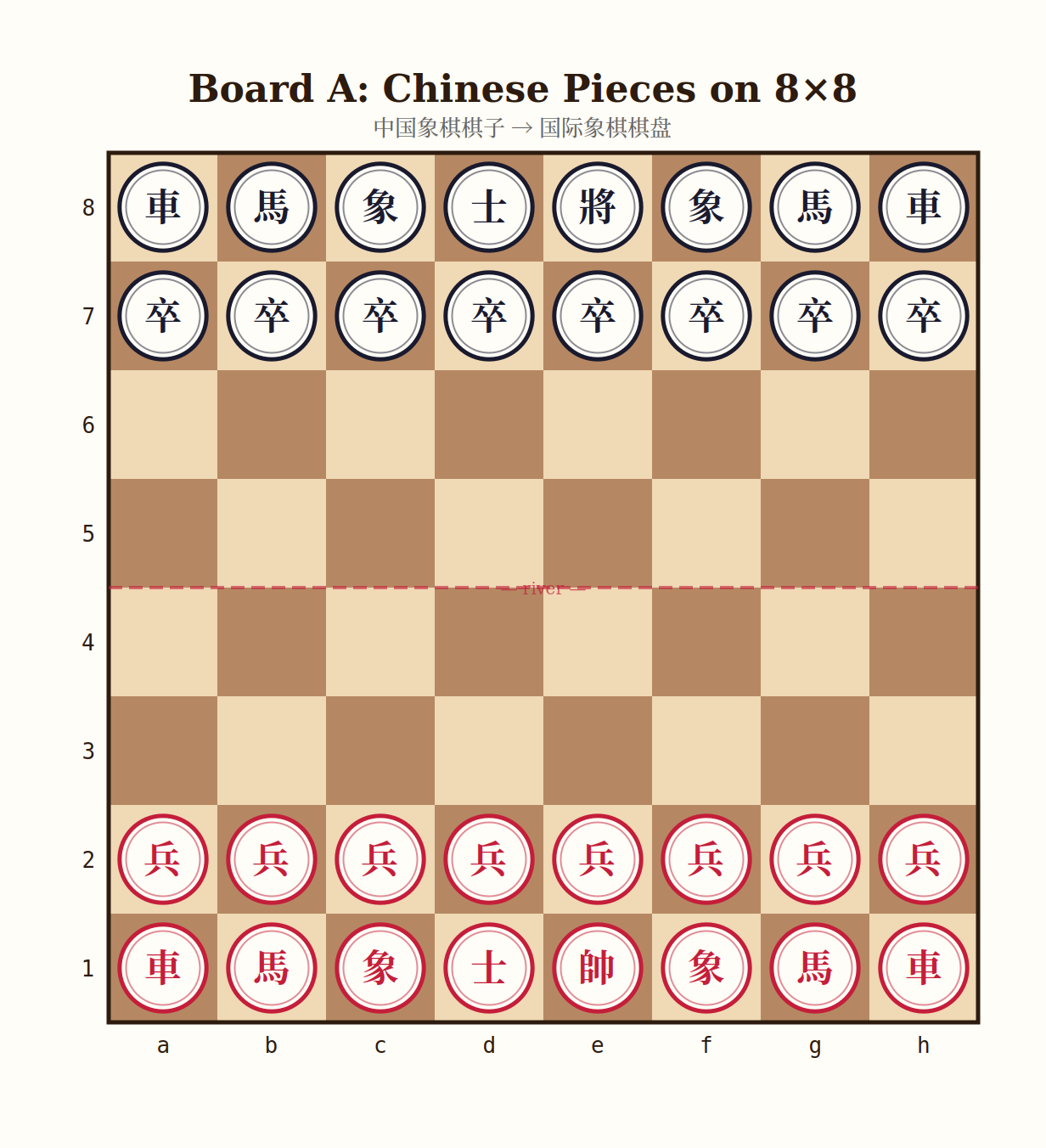
Setup
8 │ 車  馬  象  士  將  象  馬  車
7 │ 卒  卒  卒  卒  卒  卒  卒  卒
6 │ ·   ·   ·   ·  ·   ·  ·   ·
5 │ ·   ·   ·   ·  ·   ·  ·   ·
  ┆ ─ ─ ─ ─ ─ river ─ ─ ─ ─ ─ ─
4 │ ·   ·   ·   ·  ·   ·  ·   ·
3 │ ·   ·   ·   ·  ·   ·  ·   ·
2 │ 兵  兵  兵  兵  兵  兵  兵  兵
1 │ 車  馬  象  士  帥  象  馬  車
  └─a───b──c───d───e───f──g───h
Per side: 1 General (將/帥), 1 Advisor (士), 2 Elephants (象), 2 Horses (馬), 2 Chariots (車), 8 Soldiers (兵/卒).
The Advisor occupies the Queen's square (d1 / d8). The Cannon is removed entirely — it has no equivalent in International Chess.
Piece Movement
All pieces retain their original Xiangqi movement rules:
| 將/帥 (General) | One step orthogonally. No area restriction — free to move anywhere. |
| 士 (Advisor) | One step diagonally. No area restriction — free to move anywhere. |
| 象 (Elephant) | Two steps diagonally (a 2×2 jump). Blocked if the intermediate diagonal square is occupied. No river restriction. |
| 馬 (Horse) | One step orthogonally, then one step diagonally outward. Blocked if the orthogonal square is occupied. |
| 車 (Chariot) | Any number of squares orthogonally. Identical to a Rook. |
| 兵/卒 (Soldier) | Before crossing the river (the line between ranks 4 and 5): one step forward only. After crossing: one step forward or sideways. |
Promotion
A Soldier reaching the opponent's back rank promotes to any piece except the General.
Victory
Checkmate or stalemate the opponent's General.
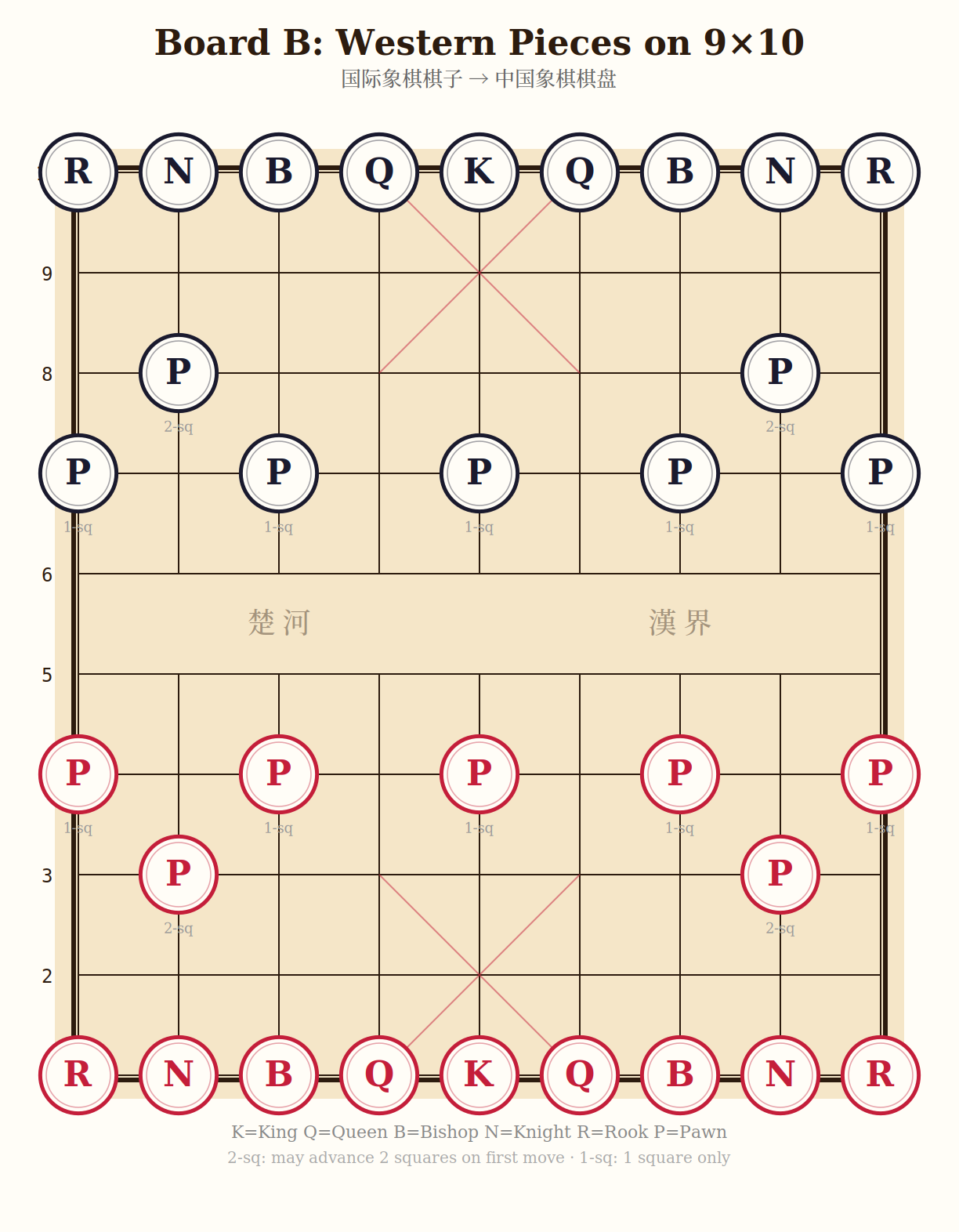
Board B — International Chess Pieces on a 9×10 Xiangqi Board
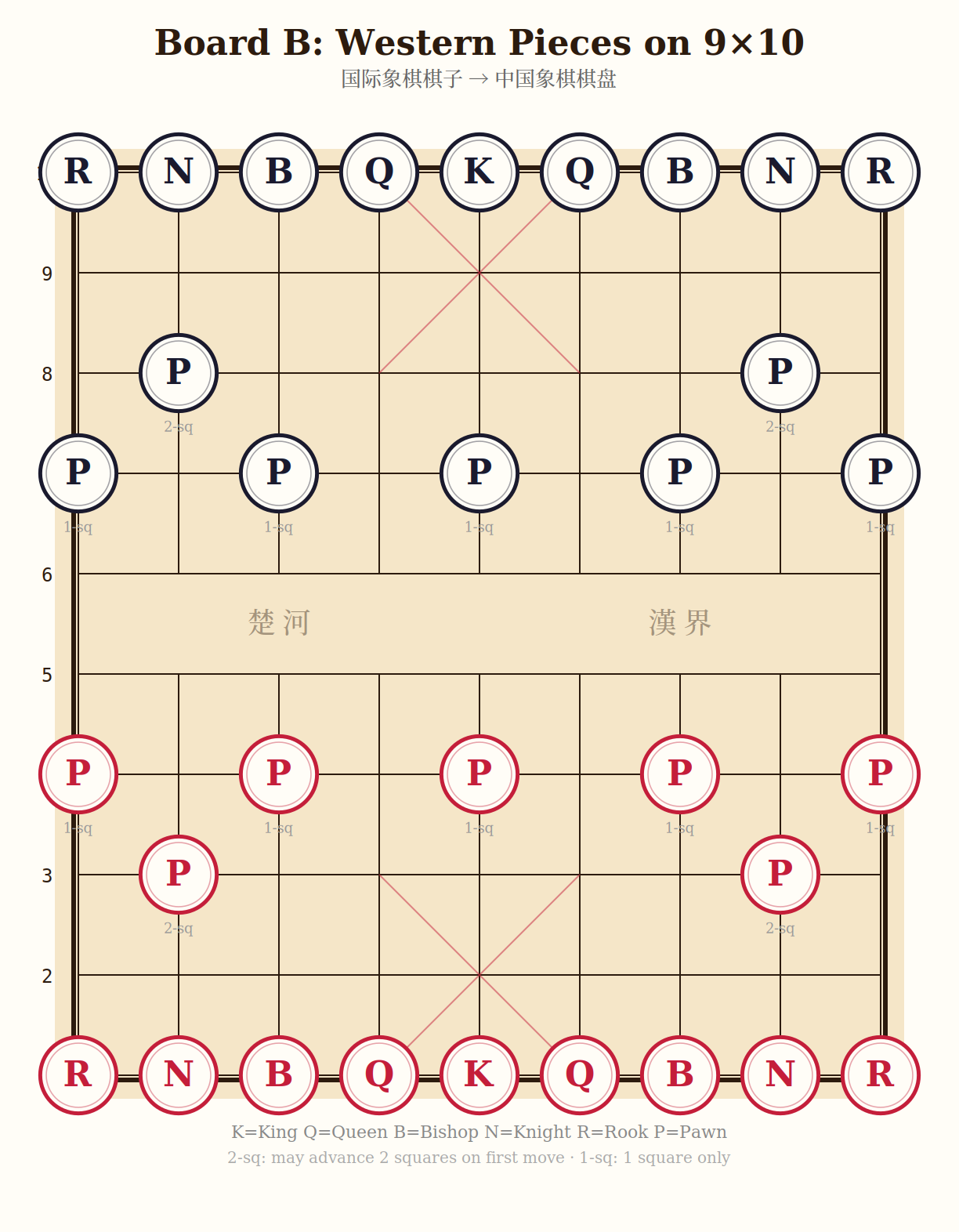
Setup
10 │  R   N   B   Q   K   Q   B   N   R
 9 │  ·   ·   ·   ·   ·   ·   ·   ·   ·
 8 │  ·  [P]  ·   ·   ·   ·   ·  [P]  ·
 7 │ (P)  ·  (P)  ·  (P)  ·  (P) ·   (P)
 6 │  ·   ·   ·   ·   ·   ·   ·   ·   ·
   │          楚  河  漢  界
 5 │  ·   ·   ·   ·   ·   ·   ·   ·   ·
 4 │ (P)  ·  (P)  ·  (P)  ·  (P)  ·  (P)
 3 │  ·  [P]  ·   ·   ·   ·   ·  [P]  ·
 2 │  ·   ·   ·   ·   ·   ·   ·   ·   ·
 1 │  R   N   B   Q   K   Q   B   N   R
   └──1───2───3───4───5───6───7───8───9
[P] = Cannon-position Pawn (may advance 2 squares on its first move)
(P) = Soldier-position Pawn (may advance only 1 square on its first move)
Per side: 1 King, 2 Queens, 2 Bishops, 2 Knights, 2 Rooks, 7 Pawns.
The two Queens replace the Advisors (columns 4 and 6). There are 7 Pawns: 2 in cannon positions and 5 in soldier positions.
Piece Movement
All pieces retain their original International Chess movement rules, with these adaptations:
| King (K) | One step in any direction. Confined to the Palace (3×3 area). No castling. |
| Queen (Q) | Any number of squares in any direction. Confined to the Palace. |
| Bishop (B) | Any number of squares diagonally. No restrictions. |
| Knight (N) | Standard L-shape jump. No blocking — jumps freely. |
| Rook (R) | Any number of squares orthogonally. No restrictions. |
| Pawn (P) | One step forward; captures one step diagonally forward. |
Pawn first-move rule: Cannon-position Pawns may advance 2 squares on their very first move. Soldier-position Pawns may advance only 1 square on their first move. After the first move, all Pawns move 1 square per turn.
En passant is preserved. If a Cannon-position Pawn advances 2 squares and lands beside an enemy Pawn, the enemy may capture it en passant on the immediately following turn.
Promotion
A Pawn reaching the opponent's back rank promotes to any piece except the King. However:
- Promotion to Queen is only available on the three Palace squares of the opponent's back rank (columns 4, 5, 6). A promoted Queen is confined to the opponent's Palace.
- Promotion to Rook, Bishop, or Knight may occur on any back-rank square, with no area restrictions.
Victory
Checkmate or stalemate the opponent's King.
Credits
- Game Design: GamearninG
- Created at: Goethe Institute Beijing — 48-Hour Game Jam (May 31 – June 2, 2019)
- Theme: "Multi-Perspective"
Links
Leave a comment
Log in with itch.io to leave a comment.